
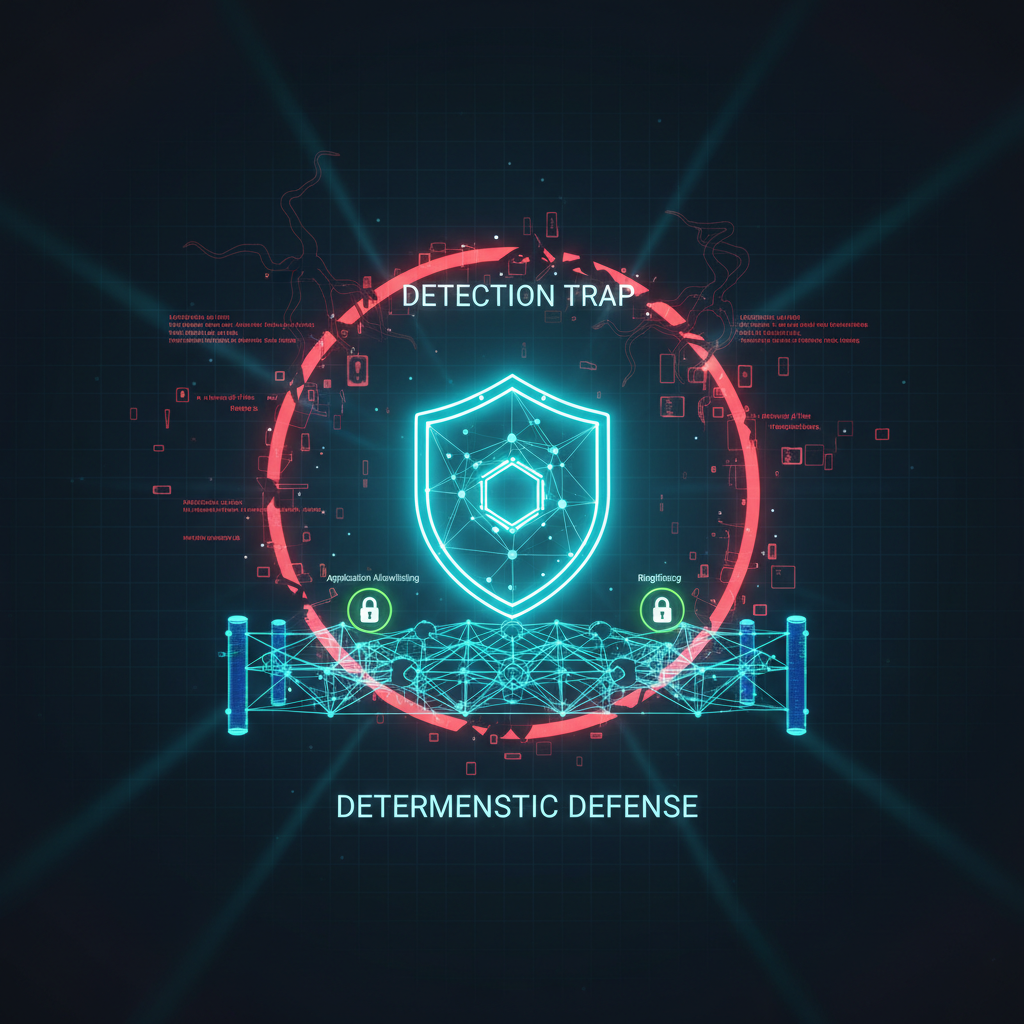
The Probabilistic Paradigm: The Operational Reality of Modern EDR
For more than a decade, enterprise cybersecurity strategies have heavily indexed on detection-and-response methodologies. Endpoint Detection and Response (EDR) and Extended Detection and Response (XDR) platforms were deployed to monitor telemetry, parse behavioral signals, and identify anomalous execution patterns. While telemetry collection remains a critical component of forensic visibility, relying on probabilistic detection as the primary mechanism of endpoint defense has introduced systemic operational fragility.
Probabilistic detection relies fundamentally on likelihoods. Machine learning models, behavioral heuristics, and indicator-of-compromise (IOC) matches attempt to answer a moving question: Does this activity look malicious? In practice, this forces Security Operations Centers (SOCs) into a reactive loop of alert triage, hypothesis testing, and post-execution containment. According to industry analyses, security engineering teams spend countless hours parsing benign behavioral deviations, while adversaries engineer attacks specifically designed to blend into baseline operational activity.
When defense relies on detecting bad behavior rather than permitting only verified good behavior, the adversary retains the asymmetric advantage. To achieve resilience against modern threat vectors, organizations must escape the detection trap and adopt deterministic architectures.
The Breakdown of Telemetry: Living-off-the-Land and Rapid CVE Weaponization
The fundamental limitation of heuristic detection becomes acute when examining modern adversary tradecraft. Attackers increasingly bypass traditional endpoint controls not through novel malware binaries, but by leveraging native, cryptographically signed binaries—a technique known as Living-off-the-Land (LotL).
When an attacker executes code through trusted utilities such as powershell.exe, rundll32.exe, or certutil.exe, the telemetry produced mirrors legitimate administrative activity. For probabilistic models, distinguishing between a system administrator running an automation script and an attacker staging lateral movement is challenging without generating substantial false positives. Recent vulnerability trends highlight this challenge:
- CVE-2023-38831 & CVE-2024-21413: Exploits that abuse trusted execution chains, allowing arbitrary code execution through routine user actions within trusted productivity applications.
- CVE-2024-30051: Windows Desktop Window Manager privilege escalation vulnerabilities, weaponized in targeted attacks to elevate permissions using legitimate Windows runtime structures.
- Living-off-the-Land Drivers (BYOVD): Adversaries dropping legitimately signed, yet vulnerable third-party drivers (such as those abused in recent ransomware campaigns) to disable EDR agents directly at ring 0.
In each of these scenarios, post-execution detection models often alert only after persistence, credential dumping, or encryption has already commenced. Telemetry cannot prevent what the operating system has already been tricked into authorizing.
Deterministic Defense: The Mechanics of Default-Deny
Deterministic security replaces likelihoods with absolutes. Rather than allowing execution by default and attempting to identify malicious behavior mid-stride, a deterministic framework implements a strict baseline: nothing executes unless explicitly permitted by cryptographically verified policy.
At Managed Zero Trust (MZERO), this philosophy underpins our operational approach. Instead of chasing telemetry signals across thousands of dispersed endpoints, deterministic control establishes immutable boundaries around the operating system. If an unauthorized binary, unapproved script, or rogue DLL attempts to load into memory, the kernel blocks execution immediately—not because it triggered a threat score threshold, but simply because it lacks authorization.
This paradigm eliminates entire categories of cyber risk:
- Zero-Day Resilience: Because unknown binaries are denied by default, weaponized zero-days with no known signatures or historical heuristics cannot execute.
- Ransomware Mitigation: Unapproved encryption payloads and secondary execution stages are blocked pre-execution.
- Alert Elimination: Rather than generating a critical SOC alert that demands immediate manual intervention, unapproved activity is simply contained at the execution boundary.
Operationalizing Determinism: ThreatLocker Modules in Action
Achieving deterministic endpoint security without crippling operational productivity requires purpose-built policy enforcement engines. Through the MZERO platform, enterprise environments leverage the sophisticated policy controls of ThreatLocker suite modules, managed and governed by our dedicated engineering team:
1. Application Allowlisting
At the foundation of deterministic defense is Application Allowlisting. ThreatLocker’s allowlisting engine operates at the kernel level, evaluating file integrity via cryptographic hash, certificate validation, and absolute pathing. It renders standard malware, script-based payloads, and unauthorized executables inert before they can load into memory, preventing unauthorized software execution across all managed endpoints.
2. Ringfencing™
Allowing a trusted application to run is only half the battle; adversaries routinely abuse permitted software to access unauthorized resources. ThreatLocker Ringfencing™ establishes granular boundaries around approved applications. For example, Ringfencing ensures that while powershell.exe or Microsoft Office applications can run legitimately, they are deterministically barred from communicating with the internet, interacting with protected file shares, or accessing registry keys where credentials reside. This mitigates Living-off-the-Land tradecraft entirely.
3. Storage Control
Deterministic governance must extend to unstructured data and external storage vectors. ThreatLocker Storage Control enforces explicit read, write, and execute permissions across USB storage devices, network shares, and local storage pools. Policies can deterministically prevent unapproved applications from interacting with sensitive file extensions (e.g., stopping unauthorized scripts from reading database files or writing mass modifications), providing a hard boundary against data exfiltration and unauthorized data encryption.
4. Elevation Control
Operating with standard user privileges is standard security guidance, yet operational friction often pushes organizations into granting broad administrative rights. ThreatLocker Elevation Control resolves this operational tension by allowing specific, approved applications to run with elevated privileges without elevating the user's underlying account. This eliminates persistent local admin rights and enforces the principle of least privilege deterministically.
The Managed Zero Trust Advantage: Operationalizing the Baseline
If deterministic architectures are so effective, why hasn't every organization deployed them? Historically, the answer has been operational overhead. Poorly managed allowlisting projects frequently resulted in broken business workflows, overwhelmed IT help desks, and eventual project abandonment.
This is where Managed Zero Trust changes the equation. MZERO decouples the security benefits of deterministic control from the administrative burden of policy governance. Through continuous learning, policy automation, and 24/7 engineering oversight, MZERO delivers:
- Zero-Impact Baselines: Comprehensive audit-mode analysis ensures legitimate enterprise workflows, developer toolchains, and background update mechanisms are mapped and permitted prior to enforcement.
- Rapid Approval Workflows: Streamlined, SLA-backed approval requests ensure end-users are not blocked when legitimate, uncataloged business software requires execution.
- Continuous Hardening: As software vendors release updates and new vulnerabilities emerge, MZERO engineers continuously refine Ringfencing and allowlisting parameters to reflect changing enterprise realities.
By shifting endpoint defense from probabilistic telemetry chasing to managed deterministic containment, organizations reduce SOC fatigue, eliminate alert noise, and establish verifiable operational resilience.
Transition from Reactive Detection to Proven Containment
Detection alone cannot secure modern enterprise architectures against sophisticated software supply chain attacks, zero-day vulnerabilities, and living-off-the-land techniques. The operational paradigm of modern endpoint defense must be grounded in mathematical certainty, not probabilistic speculation.
To learn how deterministic controls can replace alert fatigue with absolute endpoint governance, schedule a comprehensive Zero Trust architecture assessment with Managed Zero Trust today.