
The Zero Trust Paradigm and Operational Reality
Modern endpoint security has pivoted definitively from reactive detection to proactive containment. As organizations transition away from legacy signature-based solutions, Zero Trust endpoint architectures have emerged as an operational standard. Within this domain, ThreatLocker has established itself as an authoritative solution, enforcing strict default-deny policies that strip unauthorized code of execution rights. However, while the security architecture of default-deny is mathematically robust, its long-term efficacy is constrained by administrative bandwidth.
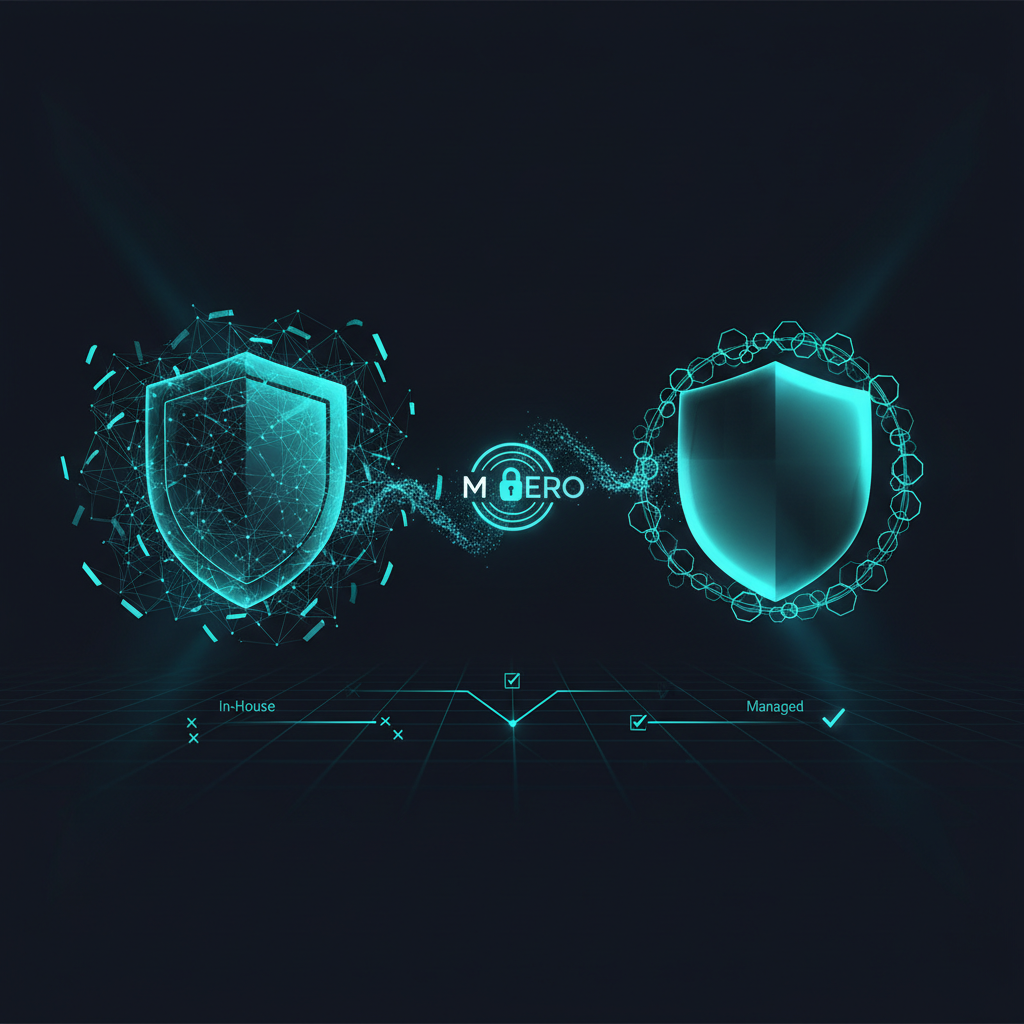
For CISOs, CIOs, and IT Directors, deploying a platform like ThreatLocker introduces a critical operational fork in the road: should the ongoing policy engineering, maintenance, and triage be absorbed in-house, or is it more strategic to engage a dedicated managed provider? This guide evaluates the resource allocation, operational overhead, and security implications of both paths.
Understanding the ThreatLocker Modular Ecosystem
To accurately weigh management overhead, leaders must examine the day-to-day administrative demands across core ThreatLocker modules. ThreatLocker is not a passive "set-and-forget" utility; it requires granular orchestration across several functional engines:
- Application Allowlisting: Halts all unapproved executables, dynamic link libraries (DLLs), scripts, and installers. Maintaining baseline hashes across active enterprise development pipelines requires continuous auditing to prevent user workflow blockage.
- Ringfencing: Restricts what permitted applications can do once running. Ringfencing stops compliant tools—such as PowerShell, Word, or native binaries—from interacting with system processes, accessing unapproved files, or establishing external network connections. Policy drift here can expose organizations to weaponized Living-off-the-Land Binaries (LOLBins).
- Storage Control: Enforces granular read/write/execute policies on external storage devices, network shares, and local directories, preventing unauthorized data exfiltration or malware staging.
- Elevation Control: Enables just-in-time administrative rights for specific applications without granting local administrative credentials to end users.
- Network Control: Provides localized microsegmentation and dynamic firewall rule enforcement directly at the endpoint, restricting lateral movement within the perimeter.
The Threat Landscape: Why Static Policies Fail
The operational burden of managing these modules is elevated by an increasingly agile adversary landscape. Recent vulnerabilities illustrate that relying on static execution baselines leaves critical blind spots.
Consider the exploitation of supply chain assets and trusted enterprise applications, such as the remote code execution flaws documented in ConnectWise ScreenConnect (CVE-2024-1709) or memory corruption bugs like CVE-2023-4863 (libwebp). In both instances, attackers leveraged trusted, signed binaries to execute payload sequences. Without active, context-aware Ringfencing to sever the bridge between legitimate web application processes and native utilities like cmd.exe or regsvr32.exe, traditional allowlisting alone cannot fully mitigate exploitation.
Similarly, vulnerabilities such as CVE-2023-38831 (WinRAR processing bypass) demonstrate how attackers disguise malicious scripts behind trusted archive utilities. Preventing these attacks requires regular policy tuning, deep telemetry analysis, and immediate rule adjustments when zero-day threat vectors surface. When managed in-house, this cadence falls squarely on existing tier-2 and tier-3 internal personnel.
The In-House Management Model: Hidden Frictions
Maintaining ThreatLocker internally grants an enterprise complete local sovereignty over security controls. However, it introduces measurable organizational frictions that must be factored into strategic planning.
1. Staffing Overhead and Specialization Gaps
ThreatLocker policy construction requires a nuanced understanding of application behavior, registry keys, and internal API calls. Generalist systems administrators often lack the deep system internals knowledge needed to craft targeted Ringfencing rules without inadvertently breaking dependent business software. When critical administrators take leave or depart the organization, the tribal knowledge governing the allowlist ecosystem departs with them, creating acute operational risk.
2. Approval Fatigue and Request Bottlenecks
In a strict default-deny framework, users inevitably encounter legitimate execution blocks during routine business updates. If an in-house security team is understaffed or preoccupied with infrastructure incidents, the Mean Time to Resolution (MTTR) for allowlist approval requests increases. This delay leads to productivity bottlenecks, user frustration, and organizational pressure to implement over-permissive "blanket approvals" that undermine the core architecture.
3. Continuous Maintenance vs. Strategic Initiatives
Tier-3 security engineers tasked with routine application hashing, patch validation, and elevation requests spend valuable cycles on administrative upkeep rather than strategic infrastructure initiatives, cloud modernization, or internal architecture improvements.
The Specialized Managed Model: Operational Leverage
Transitioning endpoint governance to a specialized service provider shifts the operational burden from an internal resource-heavy team to an external, 24/7 engineering unit. By reviewing ThreatLocker management service options, IT leaders can deploy mature operational frameworks that eliminate implementation lag.
1. Around-the-Clock Rapid Triage
Specialized management providers operate dedicated Security Operations Centers (SOCs) calibrated specifically for endpoint control. Requests for application approval and elevation are processed within minutes by dedicated analysts, maintaining business agility while enforcing rigorous verification procedures.
2. Baseline Hardening and Policy Curation
Partnering with a specialized team delivers the advantage of aggregated intelligence. Providers managing diverse environments recognize standard software updates immediately, pre-approving legitimate hashes and deploying defensive Ringfencing configurations across clients before new CVE techniques can be weaponized locally. The MZERO platform overview details how continuous endpoint validation integrates into broader security operations.
3. Mitigation of Policy Drift
Security drift occurs when temporary allowlist exceptions become permanent configurations. Managed services enforce continuous policy hygiene, auditing temporary elevation logs and revoking legacy allowances to ensure the enterprise attack surface remains tightly constrained over time.
Buyer's Evaluation Framework: Assessing Organizational Readiness
To determine whether to manage ThreatLocker internally or leverage an operational partner, IT leaders should evaluate the following structural capabilities:
- 24/7/365 Staffing Capacity: Does the organization maintain round-the-clock personnel capable of evaluating execution requests for third-shift workers or global offices without introducing operational latency?
- Endpoint Telemetry Literacy: Can internal teams differentiate between legitimate child processes spawned by productivity tools and malicious sub-process injection?
- Application Churn Rate: Does the organization deploy frequent custom, internal, or bespoke software builds that require daily hash recalculations and manual policy updates?
- Opportunity Allocation: Is it an optimal use of enterprise engineering resources to manage policy rule sets rather than higher-leverage digital business objectives?
Organizations choosing to partner with Managed Zero Trust (MZERO) unlock predictable security governance, ensuring ThreatLocker operates at peak efficacy without cannibalizing internal IT velocity.
Conclusion: Optimizing Your Endpoint Strategy
Deploying ThreatLocker is one of the most effective strategic decisions an enterprise can make to neutralize modern cyber threats, ransomware, and zero-day exploits. However, the integrity of a default-deny architecture depends entirely on operational execution. While in-house management offers localized control, it carries substantial staffing requirements and continuous operational drag.
For IT executives looking to safeguard system integrity while keeping internal teams focused on core objectives, specialized management delivers the ideal balance of enterprise protection, operational speed, and security rigor.
Ready to benchmark your current endpoint operations? Schedule a free Zero Trust assessment with our engineering team to evaluate your architecture and determine the ideal management model for your organization.