
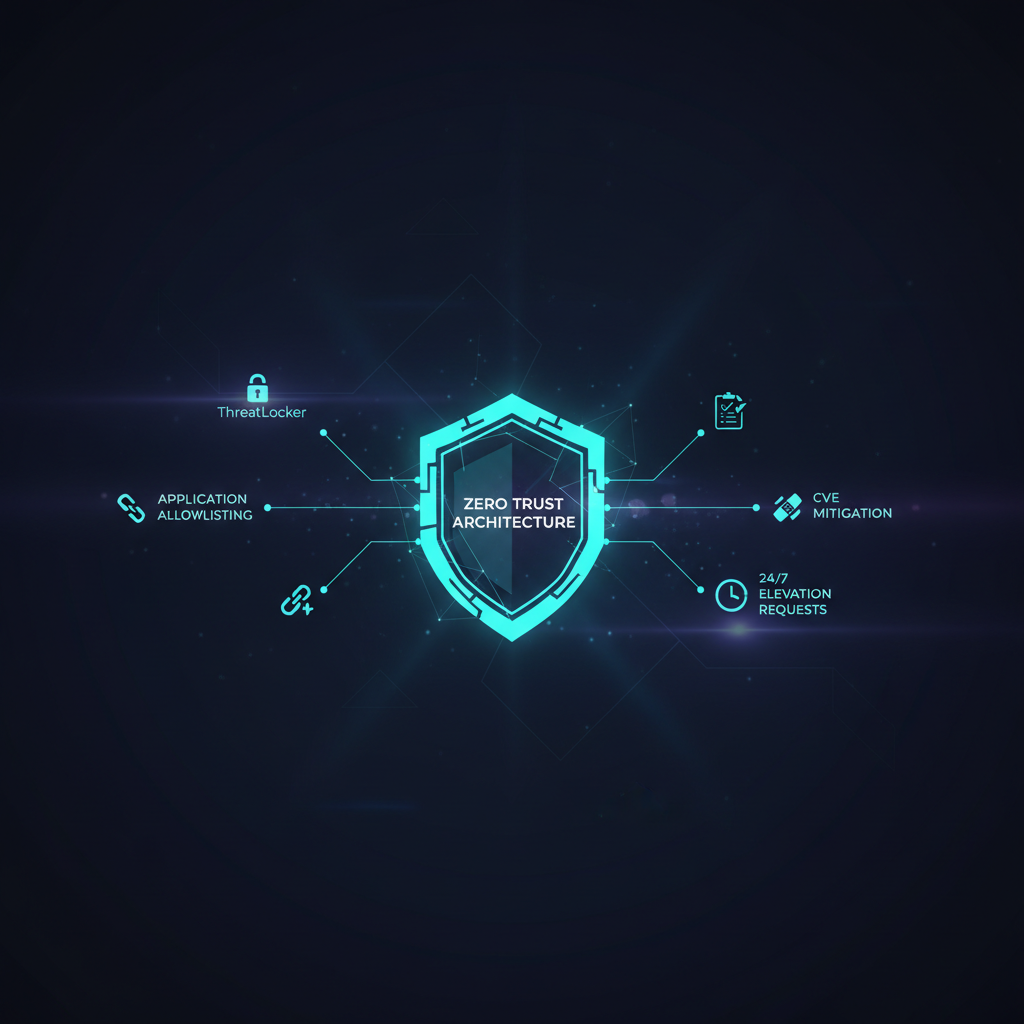
The Operational Reality of Implementing True Endpoint Zero Trust
As enterprise attack surfaces expand and adversaries increasingly leverage legitimate system tools to bypass conventional EDR, endpoint Zero Trust has shifted from an emerging framework to an operational requirement. Among preventative controls, ThreatLocker has emerged as an industry benchmark, providing default-deny application control, granular privilege management, and inter-process containment. However, acquiring enterprise-grade software is fundamentally different from successfully operationalizing it.
For CISOs, CIOs, and IT Directors evaluating endpoint security strategies, the critical decision often lies not in tool selection, but in operational execution: Should you maintain an in-house administrative team to tune and monitor the platform, or should you partner with a specialized provider for managed ThreatLocker services? Evaluating this trade-off requires analyzing technical overhead, round-the-clock administrative requirements, policy-tuning risks, and the capacity to counter emerging Common Vulnerabilities and Exposures (CVEs).
The Multi-Module Footprint: Beyond Basic Allowlisting
To grasp the true resource footprint of managing ThreatLocker internally, IT leadership must first examine the complexity of its core modules:
- Application Allowlisting: Replaces traditional default-permit architectures with strict allowlists based on cryptographic hashes, paths, and certificate signatures. It stops unauthorized executables, scripts, and libraries dead in their tracks.
- Ringfencing™: Governs what permitted software is authorized to execute post-launch. Ringfencing restricts trusted applications (such as PowerShell, Command Prompt, or Microsoft Office) from interacting with network sockets, calling critical OS APIs, or tampering with protected files.
- Storage Control: Enforces granular read, write, and execute policies on local directories, network shares, and external storage devices, preventing unauthorized data exfiltration and external malware delivery.
- Elevation Control: Enables temporary, policy-bounded privilege escalation for specific business applications without provisioning broader local administrator rights to the user.
- Network Control: Functions as an endpoint-level firewall capable of isolating systems or selectively permitting traffic based on rigorous environmental rules.
Each module delivers formidable defense-in-depth, yet each introduces ongoing administrative demands. When managed in-house, these modules demand constant oversight, continuous baseline telemetry analysis, and rigorous verification of business software updates.
The Hidden Operational Overhead of In-House Administration
Organizations that choose to maintain their deployment internally frequently underestimate the ongoing labor allocation required for sustainable operational maturity.
1. The 24/7/365 Elevation and Approval Burden
In a strict default-deny posture, software installs, unannounced vendor updates, developer dependencies, and legitimate enterprise utilities demand immediate administrative review. If an executive or field engineer requires software activation at 2:00 AM, standard business-hours helpdesk escalation fails.
When elevation requests stall, business productivity drops, prompting user pushback that can erode institutional support for Zero Trust initiatives. Providing genuine 24/7 approval support in-house requires either dedicated, multi-shift tier-2 engineering talent or an on-call rotation that introduces staff fatigue and elevated turnover.
2. Continuous Hash Management and Update Churn
Modern commercial software updates with unprecedented frequency. Development tools, web browsers, accounting platforms, and productivity suites update their executable binaries and dynamic link libraries (DLLs) continuously. An internal team must analyze change records, verify digital certificates, and systematically update hash tables across thousands of deployment endpoints to prevent unintended workflow interruptions.
Policy-Tuning Risks and Vulnerability Containment
The core objective of Zero Trust is proactive risk mitigation. However, improperly configured policies negate defensive value while amplifying administrative burden.
Mitigating Living-off-the-Land (LotL) Exploits
Modern adversaries rarely deploy crude, easily identified payloads; instead, they exploit native binaries (LOLBins) such as rundll32.exe, certutil.exe, and wmic.exe. While application allowlisting permits these critical operating system tools, missing or overly broad Ringfencing configurations leave the door open for malicious lateral movement and payload execution.
Crafting Ringfencing policies that restrict command-line interpreters from accessing the internet without breaking operational scripts demands deep, specialized security engineering. If internal administrators lack regular threat hunting experience, policies often default to broad exclusions, neutralizing the protections Zero Trust was selected to deliver.
Defending Against Zero-Days and High-Severity CVEs
Recent vulnerabilities have demonstrated that initial perimeter compromises can occur long before signatures or endpoint definitions exist. For instance, the critical authentication bypass in ConnectWise ScreenConnect (CVE-2024-1709) and perimeter flaws across Ivanti Connect Secure (CVE-2023-46805 / CVE-2024-21887) highlighted the urgency of neutralizing unauthorized child-process execution instantaneously.
Similarly, vulnerabilities leveraging Microsoft Office process injection, such as CVE-2023-36884, underscore the necessity of policies preventing Word and Excel from spawning child processes or touching executable system boundaries. In-house teams often lack the dedicated threat research bandwidth needed to synthesize vulnerability advisories and apply tailored, proactive policy adjustments across global fleets within hours of public disclosure.
Comparative Operational Matrix: In-House vs. Managed Provider
IT leaders must weigh the operational dynamics of running ThreatLocker entirely in-house against partnering with a dedicated service:
- 24/7/365 Response Availability: Internal management typically strains tier-2/3 technical personnel through round-the-clock on-call duties. A specialized provider runs a continuous operational model specifically staffed for rapid, security-conscious elevation reviews.
- Policy Maturity & Drift Management: Internal teams risk gradual configuration drift, where exceptions accumulate over time to resolve immediate support tickets. A managed partner enforces standardized, audited change controls to ensure long-term policy integrity.
- Threat Advisory Deployment: In-house teams must track CVE releases independently and author custom containment rules. Specialized providers deploy pre-tested containment rules immediately upon threat verification.
- Staff Focus: Internal oversight consumes strategic systems engineering cycles on day-to-day administrative requests. Outsourcing offloads maintenance, returning valuable time to core enterprise IT and business modernization initiatives.
The Strategic Value of Managed Zero Trust (MZERO)
At Managed Zero Trust (MZERO), we recognize that preventing execution of unauthorized code is only half the battle; maintaining user velocity without diluting security posture is the other. The MZERO platform integrates direct operational administration of the complete ThreatLocker ecosystem with comprehensive engineering expertise.
By unifying Application Allowlisting, Ringfencing, Storage Control, Elevation Control, and Network Control within a structured management methodology, MZERO eliminates administrative friction for your internal team. Security policies are continually optimized, software updates are proactively certified, and 24/7 elevation requests are handled by engineers trained to distinguish legitimate administrative workflows from active exploitation attempts.
Building a Sustainable Zero Trust Model
Attempting to manage an uncompromising default-deny platform solely with internal generalist resources often leads to one of two outcomes: high user friction and support fatigue, or sweeping policy exceptions that undermine the architecture's security guarantees. Partnering with a dedicated operational team enables organizations to realize the full defensive promise of ThreatLocker without burdening existing staff.
Evaluate your internal capacity, review your operational requirements, and determine whether in-house management or a co-managed architecture aligns with your organizational risk tolerance.
Ready to benchmark your current endpoint Zero Trust maturity? Schedule a consultation with our security architects to explore how MZERO delivers managed preventative controls with zero business disruption.