
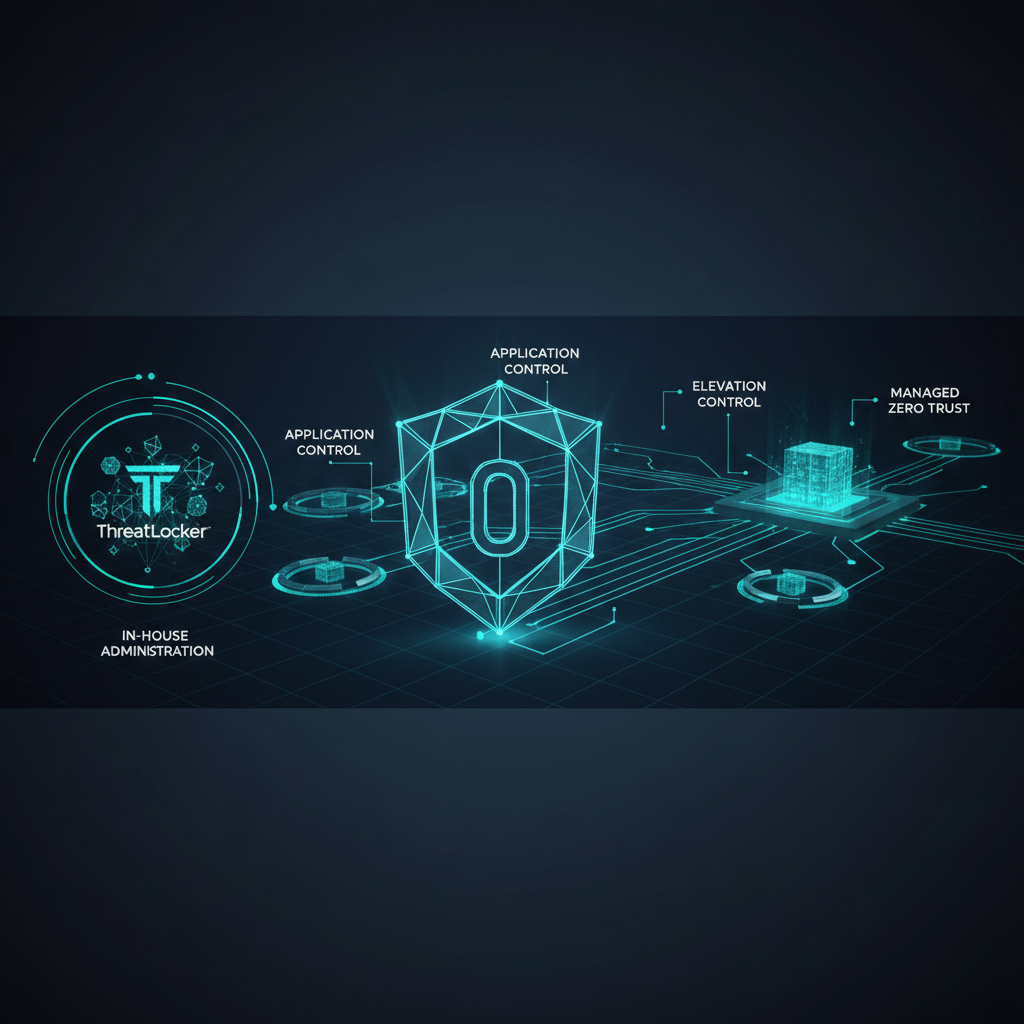
The Zero Trust Endpoint Dilemma: Architectural Strength vs. Operational Reality
As enterprise attack surfaces expand and threat actors leverage sophisticated Living-off-the-Land (LotL) techniques, traditional signature-based endpoint detection and response (EDR) tools are no longer sufficient on their own. ThreatLocker has emerged as a premier endpoint security control, establishing a resilient default-deny baseline across endpoints and servers through granular application allowlisting, ringfencing, and privilege access management (PAM).
However, implementing an architectural paradigm shift from implicit trust to deterministic default-deny introduces a crucial operational question for CISOs, CIOs, and IT Directors: Should policy operations, maintenance, and ongoing telemetry reviews be maintained in-house, or delegated to a dedicated partner?
While the administrative interface of ThreatLocker gives internal engineers complete autonomy, the true resource requirement lies not in initial deployment, but in continuous policy lifecycle management. In this guide, we evaluate the hidden operational overhead, resource allocation, and threat-response trade-offs between internal administration and dedicated managed ThreatLocker operations delivered through Managed Zero Trust (MZERO).
The Core Modules and Their Administrative Demands
To evaluate administrative overhead objectively, IT leadership must examine the continuous maintenance requirements across ThreatLocker’s core modules:
1. Application Allowlisting (Application Control)
ThreatLocker’s Application Control module blocks all unapproved executables, dynamic link libraries (DLLs), scripts, and installers by default. While this completely eliminates unknown malware, legitimate enterprise environments are rarely static. Internal administration demands rapid triage of approval requests whenever software updates, developer dependencies, or business-critical tools roll out.
When managed internally, application requests routinely create ticket queues that interrupt Tier 2 and Tier 3 engineering teams. If requests are delayed, business productivity stalls; if approvals are granted carelessly or blanket rules are deployed to reduce friction, the integrity of the Zero Trust architecture collapses.
2. Ringfencing
Ringfencing goes beyond standard allowlisting by controlling what permitted applications can do once running. It prevents legitimate utilities—such as Microsoft Office, PowerShell, or command prompt—from interacting with protected files, accessing the registry, or initiating unauthorized outbound network connections.
Maintaining Ringfencing policies requires deep insight into software dependencies. For instance, tuning Ringfencing to stop weaponized macros while allowing legitimate ERP reporting macros requires continuous testing. An in-house team unfamiliar with deep telemetry often defaults to loose restrictions or experiences unintended application crashes following vendor software updates.
3. Storage Control
Storage Control provides strict protocol and policy enforcement over external USB drives, network shares, and local file storage. Policies can restrict read/write capabilities down to specific file types, applications, or serial numbers. In-house administration requires dedicated time to audit access logs, configure exemptions for specific roles, and prevent data exfiltration without impeding valid operational workflows.
4. Elevation Control (Endpoint PAM)
Elevation Control enables organizations to remove local administrative rights while granting on-demand, time-based elevation for specific applications without providing full administrative credentials. In-house staff must evaluate each elevation request, verify digital signatures, and set expiration parameters to maintain a defensible least-privilege posture.
5. Network Control
Providing endpoint-level micro-segmentation, Network Control restricts inbound traffic based on granular rules, blocking lateral movement and brute-force attempts. In-house teams must actively manage these rules across remote, hybrid, and campus-based workforces without severing business connectivity.
The Hidden Operational Overhead of In-House Administration
When leadership considers running ThreatLocker entirely in-house, the financial analysis often accounts solely for software licensing. The deeper, often underestimated operational commitments center around human capital and operational friction.
Continuous Approval Cycles and Ticket Overhead
Enterprise applications update continuously. Modern browsers, developer platforms, and cloud-synced productivity suites push silent delta patches daily. Each delta can alter file hashes, triggering approval alerts. An in-house IT team must manage:
- 24/7/365 Request Routing: Global users, executive staff, and after-hours engineers still require software validation. Internal IT teams rarely staff 24/7 SOC desks dedicated to evaluating application hash deltas.
- Verification Diligence: Legitimate-looking files may masquerade as updates. Teams running ThreatLocker in-house often experience fatigue, causing engineers to approve files based solely on file names rather than vendor verification and reputation analysis.
- Context Switching: High-value systems architects and security engineers frequently find their focus fragmented by ad-hoc elevation and allowlist tickets.
Policy Drift and Administrative Fatigue
Over time, internal environments experience policy drift. An engineer facing an urgent deadline creates a broad wildcard rule or allows an entire folder path to restore user productivity. Over six to twelve months, these incremental concessions degrade the default-deny baseline into an audit liability, re-introducing pathways for malicious execution.
Defending Against Emerging Exploits and Modern CVEs
Threat actors continually pivot toward techniques designed to circumvent detection-only tooling. Managing endpoint policies internally demands proactive threat intelligence and continuous tuning in response to critical vulnerabilities.
Consider recent vulnerability disclosures such as:
- CVE-2023-36884 (Windows Search Remote Code Execution): Exploited via crafted Microsoft Office documents. Defending against such zero-day exploitation requires rigorous Ringfencing that prevents Office binaries from spawning secondary interpreters or reading unauthorized registry entries.
- CVE-2024-1709 and Supply-Chain RMM Exploits: Remote management vulnerabilities that allow unauthorized software execution. Application Control stops attackers from dropping second-stage payloads even if initial access is secured.
- Living-off-the-Land Binaries (LOLBins): Threat actors utilizing built-in utilities like
certutil.exe,regsvr32.exe, andmshta.exeto download and execute payloads directly in memory.
An in-house team must monitor vulnerability bulletins daily, translate threat intelligence into actionable ThreatLocker rules, test them across staging groups, and push updates across production assets. An outsourced, specialized team handles this continuous cycle as a core competency, ensuring controls are hardened against novel exploit chains before internal teams have even reviewed the vulnerability disclosure.
Comparing In-House Operations vs. Managed ThreatLocker
The strategic differences between running ThreatLocker internally and partnering with a dedicated service provider become clear when evaluating key operational vectors:
- Staffing Requirements: In-house management requires dedicated Full-Time Equivalents (FTEs) trained in endpoint privilege modeling and binary auditing. A managed engagement distributes those demands across an established, specialized operations team.
- Time-to-Approval: Internal teams tied up in infrastructure maintenance or helpdesk tickets often average hours for application triage. Dedicated managed operations provide SLA-backed approvals around the clock.
- Policy Governance: In-house policies tend to loosen over time due to operational friction. A managed provider conducts regular governance reviews, auditing hash-level rules and eliminating obsolete permissions.
- Security Depth: Internal administrators frequently rely only on basic allowlisting. Managed specialists fully operationalize advanced modules—including Ringfencing, Storage Control, and Network Control—maximizing the value of the architecture.
Strategic Alignment: Focusing Internal Talent on Enterprise Outcomes
For CISOs and IT Directors, offloading operational policy administration is not an admission of operational deficiency; it is an exercise in strategic focus. Endpoint security policies require deterministic, round-the-clock maintenance that rarely aligns with the core strategic initiatives of internal IT departments, such as cloud migration, digital transformation, and internal governance.
By leveraging the MZERO platform, organizations maintain the full defensive potency of ThreatLocker's default-deny security controls while eliminating alert fatigue, minimizing administrative friction, and securing operational continuity across all endpoints and servers.
Take the Next Step in Zero Trust Endpoint Operations
Evaluating your endpoint security model requires balancing risk mitigation against long-term operational sustainability. Discover how your organization can achieve enterprise-wide application control, hardened ringfencing, and true least-privilege access without burdening internal engineering teams.
Ready to benchmark your current operational posture and eliminate policy friction? Schedule a consultation with our Zero Trust architects today to review your environment and explore our fully managed operations.