
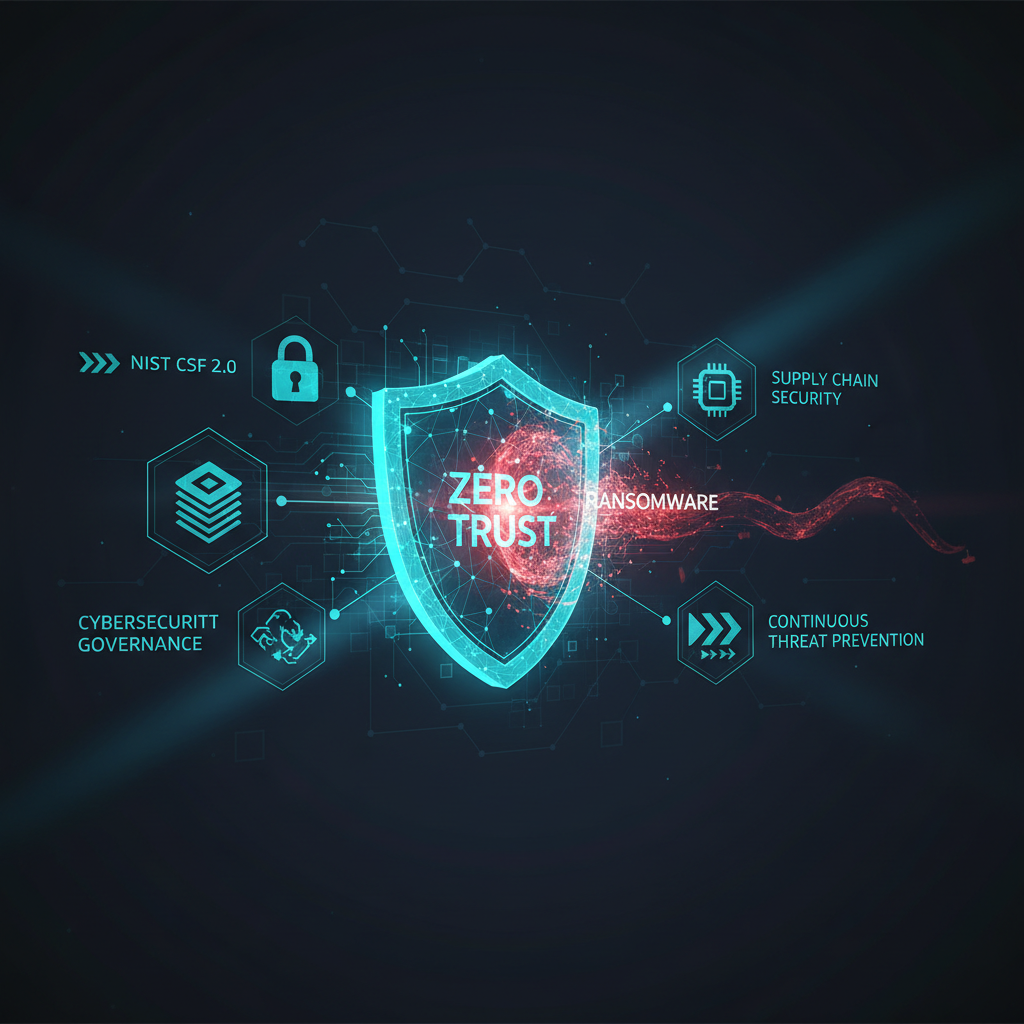
The Evolving Ransomware Threat Landscape
Ransomware continues to be a formidable and ever-evolving threat, capable of crippling organizations and incurring significant financial and reputational damage. As attacks grow in sophistication, moving beyond mere encryption to include data exfiltration, supply chain compromise, and targeted extortion, traditional perimeter-based defenses are proving insufficient. In this challenging environment, a proactive and integrated security strategy is paramount.
At MZERO, we recognize the critical need for robust, adaptive defenses. The convergence of the National Institute of Standards and Technology (NIST) Cybersecurity Framework (CSF) 2.0 and a Managed Zero Trust architecture offers a powerful synergy, providing organizations—particularly those managed by IT Directors, CISOs, CIOs, and Managed Service Providers (MSPs)—with a blueprint for enhanced ransomware prevention and resilience.
NIST CSF 2.0: A Strategic Evolution for Cybersecurity Governance
The release of NIST CSF 2.0 marks a significant evolution, expanding its scope beyond critical infrastructure to all organizations, regardless of size or sector. Key updates include the introduction of a new 'Govern' function and an increased emphasis on supply chain risk management. These enhancements are particularly pertinent in the fight against ransomware:
The 'Govern' Function: Strategic Direction for Resilience
The 'Govern' function in NIST CSF 2.0 establishes the organizational context for cybersecurity risk management, defining strategy, policies, and roles. For ransomware prevention, this means:
- Risk Management Strategy: Proactively identifying, assessing, and prioritizing ransomware risks within the organizational context.
- Roles and Responsibilities: Clearly defining who is accountable for cybersecurity decisions, incident response, and recovery, including executive leadership.
- Policy and Process Development: Implementing comprehensive policies for data backup, incident response plans specific to ransomware, and employee training.
Supply Chain Risk Management: Fortifying the Extended Enterprise
Many recent high-profile ransomware incidents have originated through supply chain vulnerabilities. NIST CSF 2.0 addresses this by emphasizing:
- Third-Party Risk Assessment: Vetting vendors and suppliers for their cybersecurity posture, ensuring they adhere to security standards commensurate with the risk they pose.
- Contractual Obligations: Including cybersecurity requirements in contracts with third-party providers.
- Continuous Monitoring: Regularly assessing the security status of critical supply chain partners.
Zero Trust: The Foundation of Proactive Defense
While NIST CSF 2.0 provides the strategic and governance framework, Zero Trust provides the tactical and operational controls necessary for execution. A core tenet of Managed Zero Trust (MZERO) is 'never trust, always verify'—a philosophy perfectly aligned with mitigating the lateral movement and privilege escalation tactics often employed by ransomware. The MZERO platform leverages several critical modules to achieve this:
Application Control: Halting Execution at the Source
ThreatLocker's Application Control module is foundational to preventing ransomware execution. By strictly enforcing a whitelist policy, only approved applications and scripts are allowed to run. This proactive measure prevents unauthorized software, including ransomware payloads disguised as legitimate files, from ever executing. If a new variant attempts to encrypt files, it simply cannot run without explicit permission, rendering it ineffective.
Storage Control: Protecting Data from Unauthorized Access
Ransomware's primary goal is data compromise. ThreatLocker's Storage Control module restricts access to critical data based on user, application, and device policies. This ensures that even if an attacker gains a foothold, they cannot access, encrypt, or exfiltrate sensitive files from network shares or local drives without explicit authorization. This significantly limits the blast radius of any potential compromise.
Ringfencing™: Containing Malicious Activity
ThreatLocker's Ringfencing™ capabilities add another layer of granular control. It dictates how approved applications can interact with other applications, networks, and resources. For example, a word processor can be 'ringfenced' to only access its designated document folders, preventing it from interacting with system processes or attempting to encrypt entire drives if it were to become compromised. This effectively isolates potential threats, preventing lateral movement and privilege escalation.
Elevation Control: Minimizing Attack Surface
Many ransomware strains require elevated privileges to execute their malicious functions or install persistence mechanisms. ThreatLocker's Elevation Control module allows users to perform specific administrative tasks without granting full administrator rights to their accounts. This 'just-in-time' and 'just-enough' privilege model drastically reduces the attack surface, making it much harder for ransomware to gain the necessary permissions to spread or cause widespread damage.
Synergy: Practical Implementation Steps for MSPs
For MSPs managing multiple clients, integrating NIST CSF 2.0 with a Managed Zero Trust strategy offers a scalable and effective defense. Here's how to implement this synergy:
- Governance Integration: Assist clients in mapping their existing security policies to NIST CSF 2.0's 'Govern' function. Emphasize incident response planning, particularly for ransomware, and ensure clear communication channels and executive buy-in.
- Supply Chain Vetting: Implement a standardized process for assessing third-party vendor security postures. Leverage the supply chain principles of NIST CSF 2.0 to identify and mitigate risks from client's ecosystem.
- Zero Trust Policy Development: For each client, develop and implement granular Zero Trust policies using the MZERO platform modules: Application Control (whitelist everything), Storage Control (protect critical data), Ringfencing™ (contain applications), and Elevation Control (limit privileges).
- Continuous Monitoring and Adaptation: Regularly review and update Zero Trust policies based on threat intelligence and system logs. Use MZERO's visibility to monitor for anomalous behavior, aligning with NIST CSF 2.0's 'Detect' and 'Respond' functions.
- Educate and Train: Conduct regular security awareness training for client employees, focusing on phishing prevention, identifying suspicious activity, and the importance of Zero Trust principles. This aligns with NIST CSF 2.0's 'Identify' function.
Conclusion
The combination of NIST CSF 2.0's strategic guidance and the operational rigor of a Managed Zero Trust architecture, powered by ThreatLocker modules like Application Control, Storage Control, Ringfencing™, and Elevation Control, provides a comprehensive and proactive defense against ransomware. For IT Directors, CISOs, CIOs, and particularly MSPs, this integrated approach moves beyond reactive measures, establishing a resilient security posture that can withstand the most sophisticated attacks.
Empower your organization or your clients with a security strategy that is not just reactive, but truly preventative and resilient. Discover how MZERO can transform your cybersecurity posture.
Ready to strengthen your defenses? Schedule a free assessment with our experts today.