
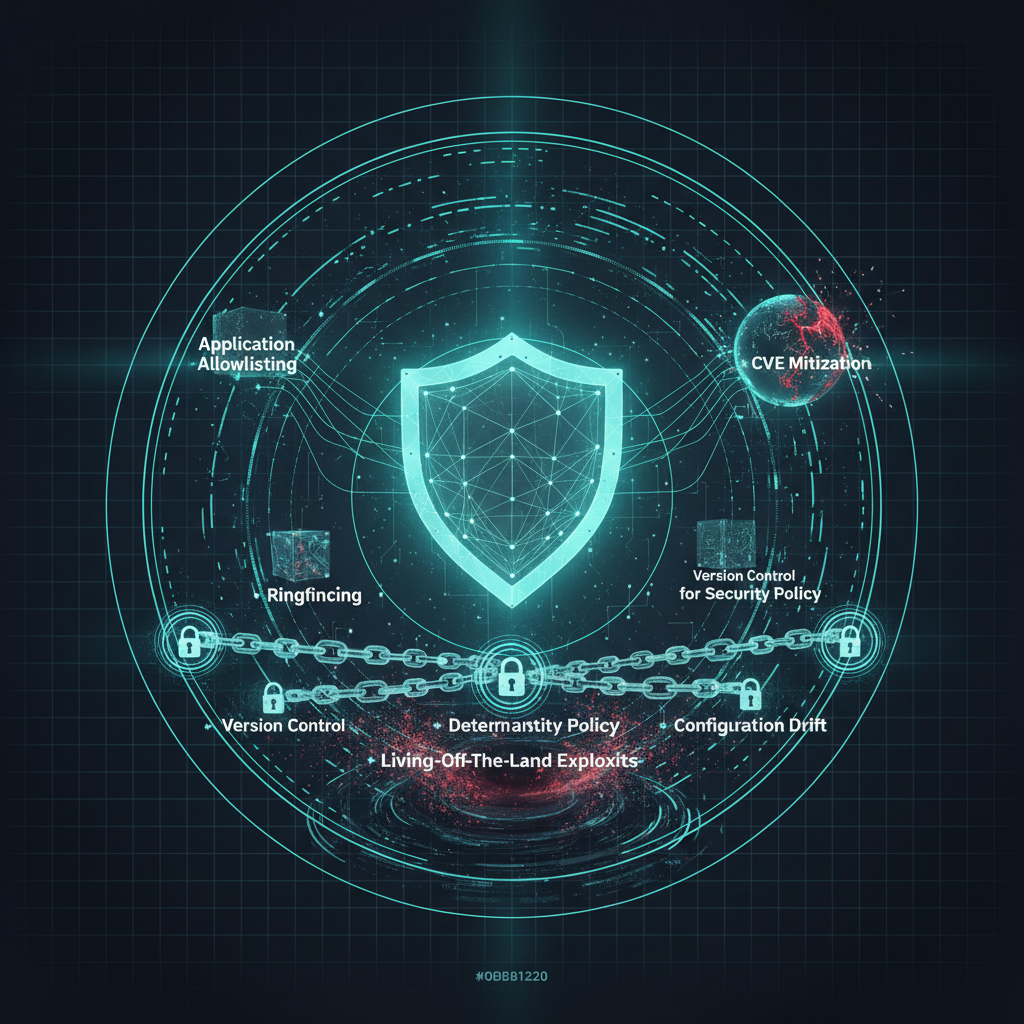
The Imperative of Deterministic State: From Statutory Code to Security Controls
A recent exploration in the legal-tech community—building a version-controlled repository for the United States Code using Git—highlighted a fundamental engineering challenge: managing massive, interconnected systems of text where subtle, unrecorded amendments can alter legal outcomes unpredictably. Statutory law, much like enterprise infrastructure, often suffers from ambiguity, cumulative revisions without clear provenance, and drift from the original intent.
For CISOs, CIOs, and IT Directors, this problem should feel intimately familiar. In enterprise environments, security policies, access control lists, and endpoint permissions often resemble unversioned legalese. Over years of operational churn, exceptions are granted, temporary ports remain open, and local administrator privileges accumulate unchecked. This condition—known as policy drift or ambient authority—is precisely where modern adversaries thrive.
To defend critical assets against sophisticated supply chain attacks and zero-day vulnerabilities, enterprise defense must shift away from probabilistic detection engines and toward deterministic, version-controlled architecture. At Managed Zero Trust (MZERO), we believe cybersecurity policy should operate with the exactness of compiled software: observable, auditable, and immutable until formally amended.
The Pitfalls of Ambient Authority and Policy Drift
Traditional endpoint security models operate on assumptions of ambient authority. If a binary is signed by a recognized vendor or passes an initial heuristic scan by an Endpoint Detection and Response (EDR) agent, it is generally granted broad permissions to interact with the underlying operating system. It can invoke scripting engines, read from local directories, access network sockets, and spawn child processes.
Adversaries do not bypass modern defenses by writing novel malware from scratch; they exploit this excess ambient authority. Known as Living-off-the-Land (LotL) tactics, attackers weaponize native administrative utilities—such as PowerShell, certutil, rundll32, and Windows Management Instrumentation (WMI)—to execute payloads within the context of trusted binaries.
When policy is loosely defined, identifying malicious activity requires statistical anomaly detection, which inherently carries a non-zero false negative rate. By contrast, when policy is declarative and deterministic—explicitly specifying which binaries may execute, what data they may touch, and which networks they can reach—the attack surface contracts dramatically.
The Anatomy of Recent CVEs: Where Heuristics Fall Short
Recent high-profile vulnerabilities underscore the risk of permissive, unsegmented process environments. Consider CVE-2024-21887 (an injection vulnerability within Ivanti Connect Secure) and CVE-2024-1709 (the authentication bypass in ConnectWise ScreenConnect). In both scenarios, attackers leveraged baseline system tools and unconstrained web server processes to drop web shells, run arbitrary commands, and pivot across internal networks.
Similarly, vulnerabilities involving file transfer tools and remote monitoring software repeatedly reveal the same operational flaw: applications designed for routine administration are allowed unrestricted outbound network access and arbitrary process execution capabilities. When a zero-day bypasses initial perimeter checks, an organization without process-level isolation is left entirely exposed.
Relying solely on reactive threat signatures to remediate vulnerabilities after disclosure is no longer sufficient. Enterprise resilience demands default-deny architectures that prevent untrusted binaries from launching and restrict authorized applications from performing unauthorized interactions—even in the event of an unpatched exploit.
Operationalizing Zero Trust Architecture via ThreatLocker Modules
Translating the principles of deterministic governance into practice requires granular controls designed specifically to enforce the principle of least privilege at the operating system layer. Through the MZERO platform, we operationalize industry-leading controls using ThreatLocker’s suite of unified modules, providing comprehensive enforcement across endpoints, servers, and remote workforces.
Application Allowlisting: The Deterministic Foundation
Allowlisting replaces the infinite ambiguity of blacklisting with a closed, mathematically verified baseline. Rather than maintaining a list of millions of known malicious hashes, Application Allowlisting operates under a default-deny posture: only explicitly permitted software is allowed to execute.
ThreatLocker’s Allowlisting engine verifies digital signatures, hash algorithms, and path integrity before any binary, script, library, or DLL is loaded into memory. This immediately neutralizes zero-day executables, rogue installer payloads, and unauthorized shadow IT tools before they can initiate a compromise.
Ringfencing™: Process-Level Boundaries
Allowing an application to run does not mean granting it unlimited freedom within the operating system. ThreatLocker Ringfencing™ acts as micro-segmentation for software, establishing strict guardrails around permitted applications.
Under a Ringfencing policy, common vectors such as Microsoft Office, Adobe Acrobat, or web browsers are strictly isolated. A weaponized Word document cannot invoke PowerShell, a browser cannot access local credentials or registry hives, and trusted diagnostic tools cannot make unauthorized outbound connections. Even if an authorized process suffers a memory corruption exploit or remote code execution (RCE) flaw, Ringfencing prevents that vulnerability from achieving secondary execution.
Elevation Control: Eliminating Local Administrative Drift
Standard users running with elevated administrative rights remain one of the most common vectors for rapid privilege escalation. ThreatLocker Elevation Control allows organizations to revoke permanent administrative privileges across the enterprise without compromising employee productivity.
Instead of granting broad administrative credentials to users, policies are provisioned on an application-by-application basis. Elevation can be scheduled, approved on demand, or restricted to specific script paths, complete with a definitive audit trail. This eliminates standard user privilege creep while insulating the organization against token impersonation attacks.
Storage Control and Network Access Control (NAC)
Deterministic policy must also extend to peripheral hardware and inbound traffic. ThreatLocker Storage Control enforces file-level policies on external drives, USB storage devices, and network shares, preventing data exfiltration and blocking unauthorized script execution from untrusted media.
Simultaneously, ThreatLocker Network Control provides dynamic firewall capabilities that restrict inbound traffic to authorized devices. By requiring continuous device authentication before ports are opened, external endpoints remain invisible to network scanners and unauthorized reconnaissance probes, significantly hardening the corporate perimeter against remote service exploitation.
Engineering Resilience with Managed Zero Trust
Much like implementing version control for complex institutional frameworks, building and maintaining a true Zero Trust posture requires continuous curation, policy refinement, and rigorous operational rigor. For internal IT directors and managed service providers, managing allowlisting policies, responding to change requests, and auditing Ringfencing rules can introduce significant overhead if handled without dedicated expertise.
Managed Zero Trust bridges this operational gap. MZERO acts as the governing engineering team for your endpoint security posture, delivering continuous policy optimization, immediate request processing, and proactive rule curation. By pairing advanced ThreatLocker modules with seasoned security analysts, we transform zero trust from an aspirational checklist into an active, deterministic reality.
To evaluate how your organization can eliminate configuration drift and implement an auditable, default-deny architecture, schedule a free security assessment with our engineering team today.